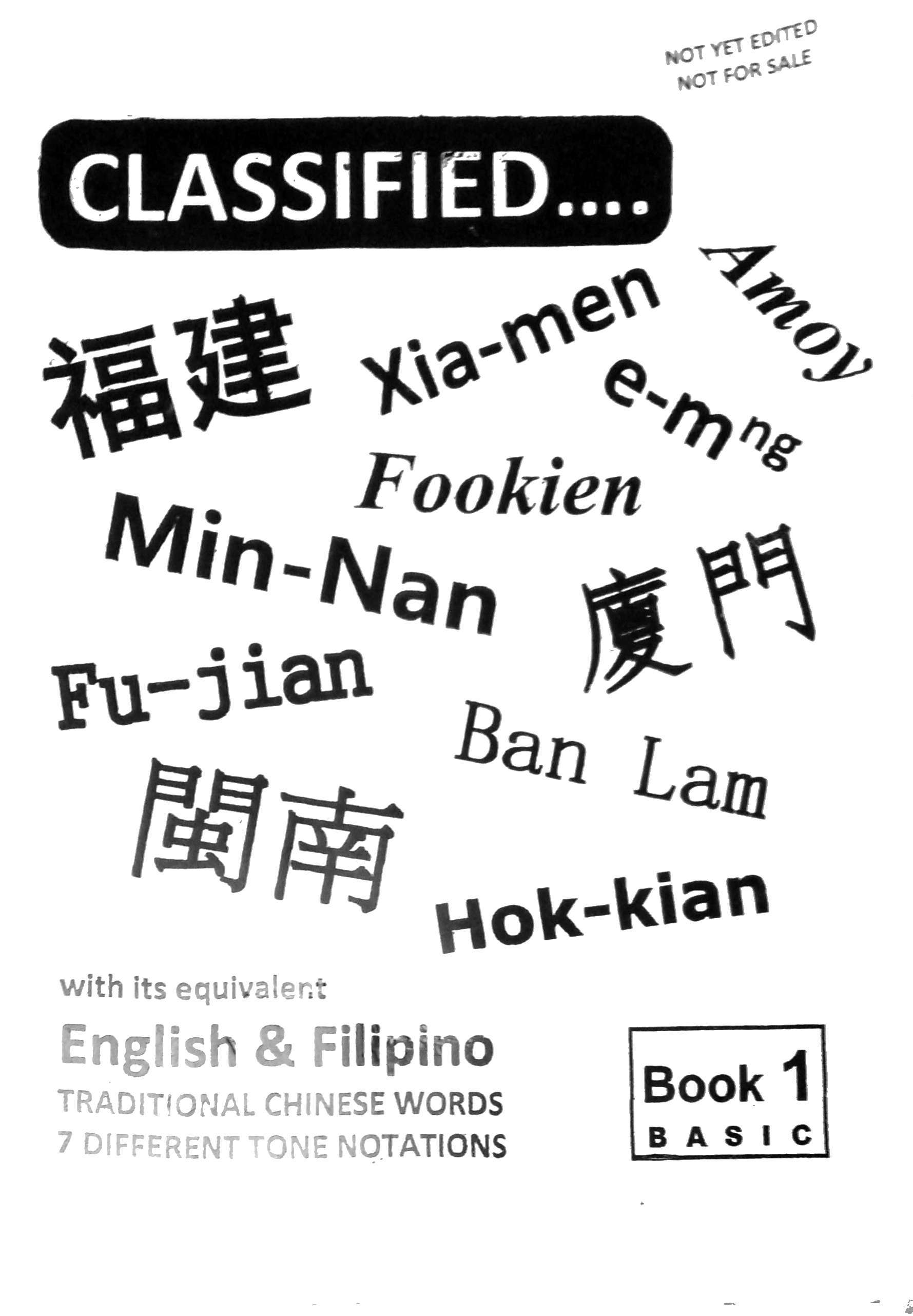
How shall we call this “dialect”? Fujian, Hokkian, Fookien, Min-Nan? Ban-Lam, Xia-men, E-m'9, Amoy?
The Hok-kian dialect has a classical pronunciation and a contemporary pronunciation (literary and colloquial pronuncia- tions, respectively). Chinese literature is written in Mandarin. It could be read in classical Hok-kian pronunciation. But some colloquial conversations do not folow the Mandarin words literally. For example the classical pronunciation for X 74 (father) ni Mandarin is “fu-gin;” ni classical Hok-kian it can be pronounced as “hu-chin.” But colloquial conversation, father is “lau-pe” (can be written as # # . )
In this booklet, we shall provide both and ty to give both dictions, with emphasis on the contemporary so as not to confuse the learners.
The contemporary pronunciation includes colloquial words with written forms that are very difficult to trace. In this volume, we shall skip the characters that are not available. Some colloquial pronunciations seem to originate from Filipino or S p a n i s h words. (Spain ruled the Philippines from 1521 to 1898.)
Migrant Chinese from the Hok-Kian province exited from the port city of Xia-Men (Mandarin pronunciation), but not all came from that city. Some arrived from nearby districts and counties like Quan-zhou, Zhang-zhou, Jin-jiang, etc. People from these places spoke variations from the Xia-Men pronunciation. nI this booklet, we shall to present the different variations, but due ot limitation of space, we shall include only the more frequent ones.
We have included the Filipino dialect “Tagalog” because some English words do not have exact equivalence to certain Chinese words. Al times, Filipino words can come ni handy. This booklet can also be used for Hok-Kian speakers to learn Filipino.
Introduction
The Hok-kian dialect has a classical pronunciation and a contemporary pronunciation (literary and colloquial pronuncia- tions, respectively). Chinese literature is written in Mandarin. It could be read in classical Hok-kian pronunciation. But some colloquial conversations do not folow the Mandarin words literally. For example the classical pronunciation for X 74 (father) ni Mandarin is “fu-gin;” ni classical Hok-kian it can be pronounced as “hu-chin.” But colloquial conversation, father is “lau-pe” (can be written as # # . ) In this booklet, we shall provide both and ty to give both dictions, with emphasis on the contemporary so as not to confuse the learners.
The contemporary pronunciation includes colloquial words with written forms that are very difficult to trace. In this volume, we shall skip the characters that are not available. Some colloquial pronunciations seem to originate from Filipino or S p a n i s h words. (Spain ruled the Philippines from 1521 to 1898.)
Migrant Chinese from the Hok-Kian province exited from the port city of Xia-Men (Mandarin pronunciation), but not all came from that city. Some arrived from nearby districts and counties like Quan-zhou, Zhang-zhou, Jin-jiang, etc. People from these places spoke variations from the Xia-Men pronunciation. nI this booklet, we shall to present the different variations, but due ot limitation of space, we shall include only the more frequent ones.
We have included the Filipino dialect “Tagalog” because some English words do not have exact equivalence to certain Chinese words. Al times, Filipino words can come ni handy. This booklet can also be used for Hok-Kian speakers to learn Filipino.